Why Choose Dental Implants?
Dental implants replace lost tooth roots and are similarly anchored in the jawbone. Implants are fixed means of replacing teeth, as they are firmly anchored in the bone. An implant is made of high-quality titanium surface that integrates with the bone. Being used increasingly over the last forty years, implants have helped millions gain back and function with natural looking tooth replacements.
Dental implants can be used in many ways, such as
- Replacing a single missing tooth
- Supporting a dental bridge replacing more than one lost tooth
- Supporting and stabilizing a denture that is removable
- Replacing all teeth with dental implants

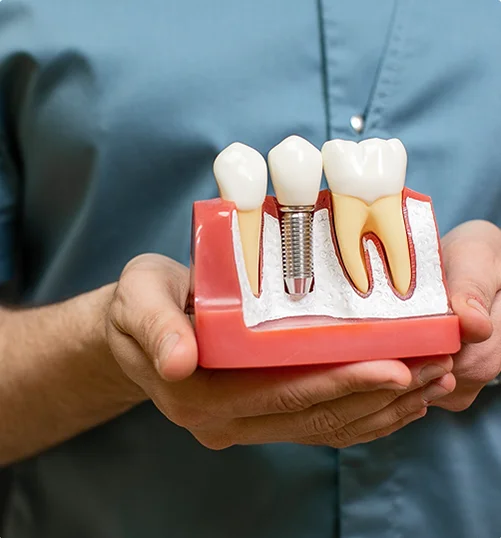
Advantages of Dental Implants
Dental implants can be considered the most ‘permanent’ way of replacing teeth, being supported by jawbone similar to actual tooth roots. So they can appear and function very similar to actual teeth.
Being made of high quality medical grade titanium, a dental implant is resistant to decay or erosion. As they stimulate the gum and bone, the loss of gum or bone tissue that occurs after teeth are lost is prevented greatly. Most importantly, an implant supported tooth replacement preserves the other natural teeth, as these don’t need to be ‘capped’ or ‘reduced’ in any way. Dental implants can used to provide fixed restorations for those who lack enough teeth to design a fixed bridge, thus saving the inconvenience of a removable denture.
What is the procedure for Dental Implants?
As implants need sufficient and healthy bone to be anchored in, a dental implant consultation requires a very detailed examination of the condition of jawbone. We perform an in- depth exam of your oral condition, health status, and restorative requirements. X-rays, CT scans or models might be needed to further analyse a case. While dental implants may not be suitable for every case, advances in dental implant science increasingly allow us to treat more people with implants using high-end clinical and technological advances such as bone augmentation.
Clinical procedures for dental implants involve an implant surgery to place the implant. This is usually performed in the dental office and under local anaesthesia, similar to a dental extraction.